Monday, June 15, 2020

Corona Daily 419: Suicides are Preventable


Triggered by yesterday’s article, I will discuss suicides again, however unpleasant the topic sounds. Suicides can be prevented by talking more about them, not less.

Research suggests during the 1918 Spanish flu pandemic, suicides grew. Surprisingly, during the First World War which preceded it, they didn’t. During the 2003 SARS epidemic, which fortunately didn’t last long, many elderly people committed suicide.

Several reasons are offered for suicides to spike up during pandemics. Mental ill-health, social isolation, entrapment, grieving for the unnecessary loss of loved ones, loneliness, feeling of hopelessness, unresolved anger or irritation, the stigma of being infected, unemployment, financial strain, domestic violence, excessive alcohol consumption and irresponsible media reporting.

Social distancing is an unfortunate term introduced without consulting psychologists. It should be physical distancing. Social isolation is one of the root causes of suicide, and now that term is freely used.
*****
The young are particularly vulnerable. Students who spent years preparing for competitive exams which didn’t happen. Undergrads analysing job market reports. Young couples with decades-long mortgages based on jobs that are no longer secure. Young people without family or state support. In the absence of savings and job security, suddenly survival is at stake.

Suicides are the most preventable form of death. There is an international association for suicide prevention (IASP). Its website has suicide crisis helplines for every country. Every year 10 September is celebrated as the world suicide prevention day. Currently, there is a sudden surge in the calls which is a good sign. Most government and private organizations offer tele-mental health, online.
*****

What can people who are not suicidal do to prevent suicides?

Keep an eye on single people, of any age. Make sure there is constant communication with them. Talk regularly to neighbours, friends, family who live alone.

Now in this age of social media, look for signs on their FB or Twitter posts. Many suicide victims had given enough clues about their intentions. Their FB friends regretted not acting on them in time.

If a person you know starts getting drunk more often or drinking more, it’s a sign of danger. Alcohol and drugs can induce suicide by temporarily killing reason - the same person wouldn’t do this when sober.

An eye must be kept on the sudden presence or increase in the means of killing. In the USA, retailers should be more careful when selling firearms. They make suicides so easy. The stock of pesticides or medicines going up is another sign somebody is contemplating suicide.

Those who had tested positive, and have recovered are absolutely like every other person. In many countries, they are stigmatized. People openly avoid them. This is the pandemic apartheid which creates a feeling of guilt. All we can do as individuals is to treat them as we would if there was no pandemic.

Encourage others to stop looking at coronavirus scorecards. The majority of the world population is not statisticians. Small numbers appear too big for them. As projected at the beginning of the pandemic, at least 100,000 people should be dying every day of Covid-19. Globally, only 5000 are dying daily. Irrespective of the number of cases, 99.99% of the population is alive. Share those facts with people who get depressed or frightened. Life can suddenly become worth living for them.

Ravi

Sunday, June 14, 2020

Corona Daily 420: Your Own Worst Enemy


Sushant Singh Rajput, 34, a Bollywood star and a talented actor, hanged himself in his bedroom this morning. Earlier this week, his former manager, Disha Salian, 28, had allegedly taken her own life by jumping from the fourteenth floor of her Mumbai building. The two suicides are not related to each other, but both were probably related to the pandemic.

Even without the pandemic, suicides are surprisingly high, more than double that of homicide at the global level. Every 40 seconds someone in the world kills himself/herself. Sapiens fame Yuval Noah Harari made a witty comment: “Statistically you are your own worst enemy. Of all the people in the world, you are most likely to be killed by yourself.”  
*****

Since March, a variety of suicides have been reported. Thomas Schafer, 54, the German state finance minister, threw himself in front of a train. He was worried that as a minister he wouldn’t be able to fulfill his obligations to the German people. A Japanese chef set himself on fire. He was scheduled to carry the Olympic torch. That was cancelled, and his restaurant shut as well. Dr Lorna Breen, 49, an emergency room doctor in New York City couldn’t bear witnessing the agonies in the covid-19 ward. Emily Owen, 19, a British girl felt the world was closing in. She was terrified of the spread of coronavirus. Daniela Trezzi, 34, an Italian nurse, was overly stressed about infecting others when she tested positive. The list is endless…
*****

There is a subtle difference between the suicide of Sushant Singh Rajput and the list above. Sushant was reportedly depressed for over six months. People suffering from mental illnesses may have suicidal thoughts. But converting these thoughts into a completed act is a long journey. Sylvia Plath in the Bell Jar portrays that process. Despite successive attempts, the protagonist of that book is alive at its end. However, the author herself committed suicide when she was barely 30 years old. If you haven’t read the Bell Jar, I recommend you don’t read it.

Super-busy people like Sushant can continue living with suicidal thoughts at the back of their mind. To denote excessive busy-ness, an idiom in Marathi says: “I have no time to consume poison”. Sounds illogical, but the idiom has an element of truth. When the body and mind are busy, a depressed and anxious person can take a break from suicidal thoughts and actions. His depression may not go away, but the mind has less time to work out an action plan.

The Mumbai lockdown of the last 2 ½ months gave Sushant’s mind too much time. He had enough success, fame and money not to worry about the financial consequence of the pandemic. But the social distancing, isolation and inactivity perhaps deepened the fears and anxieties stored in his troubled mind.

In normal times, he would now be travelling, lip-syncing songs, dancing around trees, laughing and crying into the camera, attending his film launches and signing autographs. All that was replaced by focus on an unnamed anxiety, depression and suicidal thoughts. Sushant is a collateral victim of the coronavirus.

Ravi

Saturday, June 13, 2020

Corona Daily 421: The 4-3-2-1 Football Game


The 91-year old La Liga is Spain’s top football league. Even if you are not a football fan, the names Lionel Messi or Real Madrid would sound familiar. Messi is the all-time top scorer of La Liga. Real Madrid and Barcelona generally compete for the season’s trophy.

Some six months ago, on 15 December, a league game was played between Rayo Vallecano and Albacete. Rayo is a Madrid club, and this was a home game played at the Vallecas stadium in Madrid. Rayo fans are traditionally left-leaning, anti-fascist, and more aggressive than average football fans (meaning they won’t stop at anything). In that game, the opponents Albacete had a Ukrainian player called Roman Zozulya. Rayo fans, for reasons best known to them, think Zozulya is a Nazi supporter.

They turned for the match with posters saying “this is not a place for Nazis.” When the game began, they started chanting anti-Zozulya songs, with ‘Nazi’ in the refrain. Referee Jose Toca’s whistles could occasionally halt the game on-field, but they couldn’t stop the chanting. The relentless abuse continued throughout the first half. Eddy Israfilov, an Albacete player, was shown a red card and sent back. Other than that nothing happened in the 45 minutes of play. The score was 0:0.

During the interval, Zozulya’s team decided they couldn’t take the mass musical abuse any more. Rayo Vallecano agreed with them. The referee gave his consent to halt the game, and resume it in future once a mechanism was found to control the crowd’s emotions.
*****

The logistics of La Liga are complex, and the day on which the game was set to resume fell on a day after the Spanish lockdown. Already thousands of Spaniards were hospitalized, and hundreds dead, when La Liga came to a complete stop. For nearly three months, no football would be played.

On 8 June, the Spanish Prime Minister Pedro Sanchez gave the green signal for La Liga’s resurrection. It is noteworthy that schools and universities in Spain remain shut, but football has resumed. Spain understands life’s priorities well. Of course, the games can be watched only on television, no spectators please.

Officials discussed the unprecedented resumption. Playing after three months of inactivity, no pre-season and no fans. And we jump straightaway into a full football game?

No, said one clever official. Not a full game. Let’s start with the unfinished half-game.
*****

On Wed. 10 June, La Liga’s first resumption match took place between Rayo Vallecano and Albacete.

Players from both sides arrived at the stadium wearing masks and gloves. Their temperatures were checked. Unlike in Germany, they were not tested for corona. A special team was busy disinfecting every ball their feet would touch.

Eddy Israfilov tried to argue he should play. In fact, he had played a few games after the suspended December game. Shouldn’t a red card have an expiry date, he asked. He was being punished for his offence six months ago, was it fair? Yes, it was, said the referee. As a result, Albacete played with 10 players, Rayo Vallecano with 11. Rayo scored a single goal and won the game.

Roman Zozulya played for the entire 45 minutes. There was nobody in the stands to abuse him.

The title “The 4-3-2-1 football game” doesn’t refer to any field formation. The game took 4321 hours from start to finish, becoming the longest game in football’s history.

Ravi

Friday, June 12, 2020

Corona Daily 422: Quarantine Pod


Months of social distancing showed that despite whatsApp and Zoom, we remain social animals. We miss meeting people in person. How closely we interact with known and unknown people became clear when we tried to keep the absurd two meters distance from others.

For a long time, we may continue to be confined in some ways. Jail inmates who interact with one another are happier than those in isolation cells.

On 4 June, researchers from Oxford suggested three distancing strategies for gradually moving out of isolation.

First, they recommend limiting interaction to a few repeated contacts, by forming a social bubble. To give an analogy: rather than eating once in five different restaurants, eat at one trusted restaurant five times. You will intake the same calories, sacrifice variety, but reduce the risk of food poisoning.

Second, seek similarity across contacts. The closer they live from you, the better. Age, interests, political views or children of similar ages may be a factor. Employers can form a workers’ bubble, and schools a teacher/students bubble.

Third, strengthen communities using triangular strategies. Meaning, choose bubble partners with whom you may have lots of common friends. In Facebook language, those with whom you have maximum mutual friends. That way your interaction outside your bubble becomes less risky.
*****

Forming of social bubbles is called strategic distancing. Instead of a total self-isolation (risk for sanity), or a free-for-all mixing (virus risk); the proposal emphasizes on similar, community-based, repetitive contacts. The Oxford paper recommends that teams of doctors at a Covid hospital should also be formed into bubbles, given the same shifts, and kept away from other doctors to reduce transmission risk.

Belgium, with the highest per capita death among developed nations, allows every house to invite up to four guests. New Zealand allowed meeting with up to 10 people. This does not mean meeting any ten people, but forming a bubble of ten people. Meet with them repeatedly, and try not to meet anyone else. As the situation improves, you keep increasing the size of the bubble.
*****

“Social bubble” or “quarantine pod” (even quaranteam) is a Covid buzzword.

Once you or your family decide to form a bubble (pod) with another family, the other party’s willingness needs to be judged. A bit like a marriage proposal.  If the other party accepts, both sides need to agree many things in advance. Does everyone wear a mask? How do you wash groceries? The procedures you follow on returning home. Do you order any takeaway food? How often do you go out, in what form of transport, and why. (Sounds like a pre-nuptial agreement). This agreement is based on trust. The bubble is as safe as its least safe member. And the price is high. Any member getting infected sends both families into 14-day isolation.

Would it be offensive for someone to reject a bubble offer from friends? Not necessarily. Just like we keep marriage and friendships separate, it is possible to keep social bubbles separate from friendships. The closest friends may be located too far for bubble-forming.  Not very likely, but some people may prefer to form bubbles with relatives.

If, for some reason, the bubble bursts, the ethical thing for both sides is to have a 14-day cool-down period before switching over to a new bubble. And then start all over again.

Ravi

Thursday, June 11, 2020

Corona Daily 423: Mum or Girlfriend


To the delight of the English people, Boris Johnson explained the concept of “Support Bubbles” to be operational from Saturday, 13 June. For nearly three months, singles in England (and there are more than 8 million of them), have been deprived of company. They have not met their families, friends, and lovers. Forming support bubbles offers an opportunity for a reunion. The rules are exclusively for the English, not Scottish, Irish or Welsh. The kingdom doesn’t unite in loneliness.

Support bubbles will allow any two houses to form a bubble, provided one of the two houses has only one adult (the lonely adult who needs support). Forming a bubble makes them a de facto single household. They can meet, eat together, stay overnight, and come as close as required by their relationship. Children are not counted, meaning a single mother staying with two children is still one adult. She can combine with any household of any size. In this fashion, Saturday onwards, every English person comes out of solitary confinement.

That’s the carrot. Now the stick. Once you form a bubble with another house, both the households can’t form bubbles with a third house. Such pandemic infidelity is not permissible. If one member of either house gets infected or tests positive, both houses go into quarantine for fourteen days.

English media is abuzz with readers seeking clarity on the new rules.

One set of grandparents haven’t seen their grandchildren for three months. Can they see them now? No, sorry, says the advisory. Grandparents living together don’t qualify. If one of them was a widow or a widower, by all means that person could form a bubble with his/her grandchildren’s family.

But, the advisory cautions, if the widowed grandmother has several children, she can choose only one of them. If she chooses John over Eddie and Martha, then she is allowed to mix only with John’s family, and hug only John’s children.

Two romantically involved singles can form a bubble, live in the houses of each other, and stay overnight. However, it is important to remember the rule of one single party in a bubble. If four young boys are sharing a house, only one of them (say Ian) can meet with his girlfriend (say Emily). As soon as Ian does, the remaining three automatically become part of that bubble. And if Emily is sharing her house with another girl, then Ian is prohibited from forming a bubble with Emily. Because neither Ian nor Emily is living alone.  

All English people face tough choices. Some men have not met their mother or girlfriend, at least not officially. Now they must choose between the two. Single men can form a bubble either with mum or girlfriend- not both.

And the process doesn’t end once you decide. The person or the house you want to form a bubble with must agree to bubbling with you. For all you know, they may prefer to form a bubble with someone else.
*****

Having a PM who has studied at Eton and Oxford usually results in super-intellectual regulations. Of course, in a democracy like England, nobody takes them seriously.

However, forming Social Bubbles (unlike support bubbles) is an interesting concept, which I will discuss tomorrow.

Ravi

Wednesday, June 10, 2020

Corona Daily 424: Honda Hit by a Virus


On Monday, 8 June, Honda admitted their control systems had been attacked. The company was unable to access its own servers or use emails. Production and shipments, already hit hard by the lockdown, stopped. Honda employees worldwide were asked to go home.

Honda, the Japanese company, is the world’s leading motorcycle maker for the past sixty years. Always in the top ten carmakers’ list, its turnover is $150 billion. It is an excellent target for cyber crime.
*****

Experts believe Honda has been attacked by the Ekans ransomware. (Read Ekans backward to understand its toxicity). First observed in December 2019, it encrypts data and leaves a ransom note. Industrial control systems usually shut down as a result of the attack.

Imagine on returning home, you find someone has locked it. You can’t get inside. A note left at the doorstep asks you to pay money in order to get the key to re-enter your house.

To put pressure on the victim, the cyber criminals can auction some of the stolen data online. In such auctions confidential cash flow analyses, company’s future plans, distributor lists, vendor agreements and images of employees’ driving licenses have been sold. If our bank or our government’s tax department were to be hacked, we may find our most intimate financial details sold to criminal gangs.
*****

Is this related to the pandemic? It probably is.

Work From Home (WFH) is an absolute nightmare for IT managers. Any individual employee can be lured to download a link he shouldn’t. Since the beginning of the pandemic, thousands of Covid-links, ‘helping the poor’ sites and dashboards have been used by cyber criminals. Johns Hopkins University had to issue a public statement on malware disguised as a Covid-19 map. Unfortunately a few thousand non-suspecting people had already downloaded the impostor map.

Several poly-criminal, multinational gangs now give priority to cyber-crime. When wildlife trafficking stopped in March and April, some organized crime groups switched over to cyber-crime.

Because they operate in cyberspace, it is difficult to catch the operators. Like Al-Qaeda in the real world, these operators are often known by the ransomware they promote. DoppelPaymer and Maze are large organizations that deploy and facilitate the payment of ransomware. They are happy to take payment in virtual currencies like bitcoin, making it even more difficult to trace them. On 18 March, in a press release, Maze promised to stop attacking health organizations (but not pharma companies, because they are for profit). Most cyber criminals have said if they accidentally target hospitals, nursing homes, or health agencies, the victim should contact them (contact details are given anyway to enable ransom payment).  They will decrypt for free.
*****

Times are such that we need to protect both ourselves and our gadgets from viruses. Your devices must have strong anti-malware protection. It is best to avoid downloading anything non-essential. You may think of it as internet social distancing if you like. If you are working from home, your employer’s safety is in your hands.

However, if you own a Honda vehicle, your contact details may already be in the hands of a cyber-gang.

Ravi

Monday, June 8, 2020

Corona Daily 426: Brazilian Miracle


Brazil, at 212 million, is the world’s sixth most populous country. Its coronavirus infections and deaths are second only to the USA. Testing is abysmally low. The University of Sao Paolo and other researchers have published studies suggesting the real cases are 16 times the reported cases. Cities like Amazonas with lack of health care are burying five coffins at a time in mass graves. Hospitals around the country are shattered and in a mess. Since the beginning of June, daily deaths have exceeded 1000. But soon, starting today, all this is going to change. It’s possible in a few weeks; Brazil will be virus-free. The credit for the transformation must go to Jair Bolsonaro, its president.
*****

For those who don’t know him, he is best described as Brazil’s Donald Trump, but worse. (Yes, such a thing is possible). He is an ex-military man. Since the beginning of the pandemic, he has called Covid-19 a “little flu”. It’s a media trick, global mass hysteria. Jobs and the economy are more important, and as Brazil’s president he opposes any lockdowns. When asked about the high mortality, he said death is everybody’s destiny. Some will die because such is life. However, God is Brazilian, the cure is right here.

Just like the USA, Brazil has a federal structure. Governors and mayors have the authority to take certain steps for their states. But as president of the nation, Bolsonaro has been opposing lockdown policies, arranging rallies of his own and shaking hands, encouraging his supporters to oppose closing factories, tweeting to say Brazil should remain open.

Luiz Mandetta was Brazil’s sensible health minister, believing in science, health experts and data. He advocated lockdowns, social isolation, testing, tracing. Bolsonaro sacked him on 16 April. Nelson Teich, the new health minister, was expected to be loyal to the president. Despite his objections, Bolsonaro was publicly marketing Chloroquine, a malarial drug, for Covid-19. Behind Teich’s back, Bolsonaro signed a presidential decree opening all gyms, beauty salons and barbers across Brazil. The decree termed them as essential services. On 15 May, Teich resigned. Every health minister gets sick of Bolsonaro’s company. Now the president has filled the ministry with army generals, with no health minister appointed yet.
*****

Bolsonaro doesn’t like cumulative numbers. Because no matter what, they always go up.

The Brazilian miracle began last week. In a daily bulletin on TV at 7 pm, the health ministry updates Brazilians on the coronavirus situation. The bulletin includes total infections and deaths, new infections and deaths and other relevant data. On Wed. 3 June, the ministry postponed the bulletin from 7 pm to 10 pm. We can get better data by 10 pm, it said. On Friday, 5 June, the ministry’s official website was cleaned up. All past data regarding infections and deaths was wiped out. Bolsonaro tweeted that in future new adapted data would be presented. The cumulative data will not be shown any more, because it doesn’t portray today’s situation.

On Saturday, 6 June, the Johns Hopkins dashboard removed Brazil, but reinstated it on Sunday, until further clarity is obtained.

Please don’t be surprised if in a few days you hear the news of Brazil becoming free of coronavirus. No numbers, no problems.

Ravi

Sunday, June 7, 2020

Corona Daily 427: Novel Life of an Air hostess


A friends’ elderly parents are trapped in Mumbai, while their son lives in New York. They usually stay with him, but happened to be in Mumbai during the lockdown.

Another friend, M., is an air-hostess with Air India. AI flies a Mumbai-Newark non-stop 16 hour service. The 93-year old man, and his 85-year wife, would like to take that flight when an opportunity presents itself. I wanted to know how well they would be taken care of on the flight. I called M. to check.
*****
M answered.

“Are you home or abroad?” That’s the first question I always ask M.
“I am in Mumbai.”
“Great. A. must be happy to see you.” A. is M’s school-going son.
“Haven’t met him yet. I am in Mumbai, but not at home.”
“Oh, on the way from the airport?”
“No, in a hotel. Haven’t got my results yet.”
“What results?”
“On arrival, they take our swab test. Then we are sent to a hotel, where we wait for the results. If it’s negative, we can go home. Takes at least 48 hours. I should get it tomorrow.”
“You will go home tomorrow then.”
“It depends. We also have to do a test before departure. Until that result comes through we can’t fly out. I may have another flight soon. Without going home I can use the arrival test and fly out.”
“Looks strict.”
“Yes, you know what happened to the Moscow flight, don’t you?”

Yes, I knew. On Saturday, 30 May, when flying the AI plane to Moscow, its pilot received a message saying his test result was positive. The plane was above Uzbekistan. He immediately turned around and brought the plane back to Delhi. A human error, somebody had read his result as negative.
*****

I explained to M the situation with the 93/85 couple. They will have a business class, maybe a first class ticket. They will be taken good care of, won’t they, I asked M.

“The class doesn’t make any difference. We are not allowed to service any passengers.” M explained. “We don’t go anywhere close to them. The passengers must have Arogya setu (India’s contact tracing app) on the smartphone. Without that they can’t travel. On the 16-hour flight, meals in boxes and drink bottles will be kept on their seats in advance. Also gloves, mask and a sanitiser. They must wear the mask and gloves.”

I imagined the Indian air-hostesses in sarees wearing masks and gloves. Do you also wear them, I asked M.

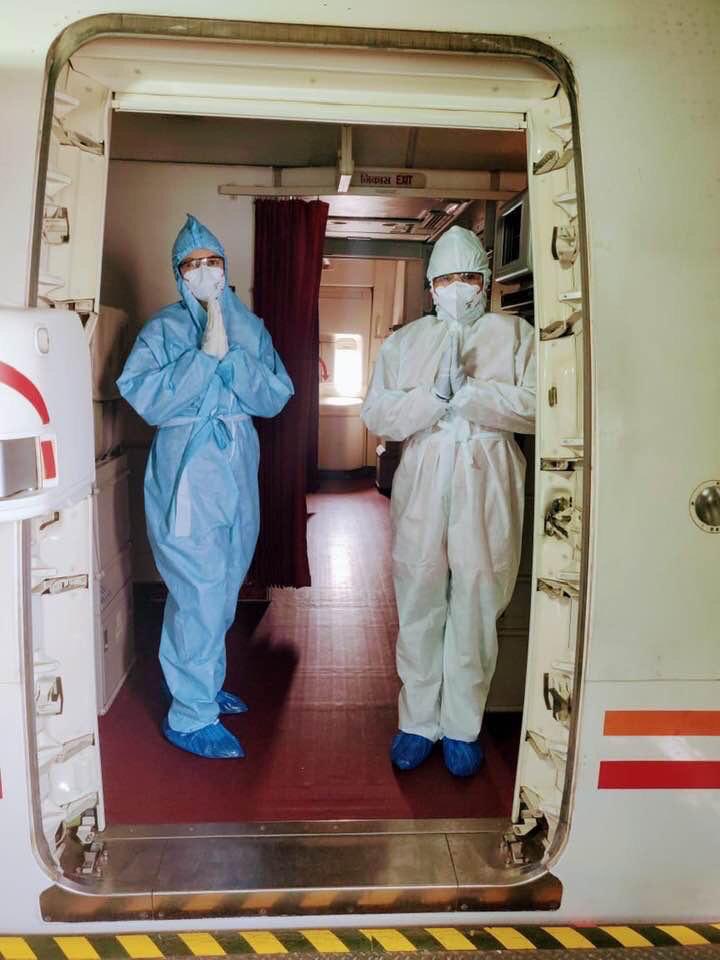
“Oh, we wear everything. We wear Hazmat suits, masks, face shields and gloves. Wearing all of it, we just sit quietly through the flight. What a nightmare. Hot, humid and suffocating. And you can’t imagine the acrobatics when we go to the loo. Some pursers have started wearing diapers. On arrival, the Hazmat suits are disposed off.” M said the suits had a price tag of Rs 3000 ($40) printed on them.
“With so much protection, why do they need to test you on arrival?” I asked.
“Protection is not guaranteed. Some pilots and air-hostesses tested positive. In Mumbai, they are then sent to the Raheja hospital. They stay there until they test negative.”
“M, you are like frontline soldiers. Are they compensating you for that?” I asked.
“Well, we continue to get our salaries.” M said with pride in her voice.
*****

Ravi


Saturday, June 6, 2020

Corona Daily 428: Patient 91 in Vietnam


The Vietnam government publishes information about each Coronavirus case. For privacy reasons, patients can’t be named, only numbered. In March, for example, newspapers mentioned that patients 88, 89 and 90 were Vietnamese girls studying in Europe or the US, who had flown to Ho Chi Minh City.

Patient 91 was a 43 year old British male, living in district 2 of Ho Chi Minh City. A pilot with a Vietnamese Airline, Ho Chi Minh was his base. Between 13 and 18 March, he ate and drank at different bars and restaurants. The well known Buddha bar and grill is close to his house. On 14 March, he attended a party there. On 16 March, he piloted VN 272 to Hanoi and VN 607 back on the same day.

On 17 March, he felt feverish, tired, and started coughing. On 18 March, he was admitted to the hospital of Tropical Diseases. His X-ray showed damage to the right lung tissue. As per procedure two swab samples were taken. Results of all tests were positive. Immediately local authorities locked down Ascent apartment, where he lived with 764 residents, including 158 foreigners.

On 8 April, the British pilot began to deteriorate. Vietnam’s Ministry of Health appointed its best experts to look after the case. The government sought a rare coagulation (blood clotting) drug from abroad. By mid-April, patient 91 went into coma. He was put under ECMO (extracorporeal membrane oxygenation) intervention, actively resuscitated with mechanical ventilation, put on antibody-filtered dialysis and given antibiotics and anti-fungal drugs.  

On 15 May, Nguyen Van Vinh Chau, the hospital director said the pilot’s lungs were seriously damaged and a transplant was essential. Vietnam mounted an all-out effort. More than 50 people offered to be lung donors. Patient 91’s parents are not alive. The Vietnamese hunted down his closest relatives in the UK to get permission for a lung transplant.

Then doctors discovered patient 91 suffered from cytokine storm syndrome, where the immune system overreacts to the virus and releases too many cytokines (proteins released by white blood cells), damaging the organs. The doctors kept treating each condition. In total, Vietnam spent $215,000 treating patient 91.

On 27 May, he awoke from coma. He had been on life support for two months. When checked, his lungs were working 20-30% as compared to the earlier 10%. Drinking sugar water, his limb strength began improving. His latest Corona tests were negative. Soon he was off dialysis.

On 3 June, he was disconnected from the ECMO machine, after 57 days. He cried when he saw the nurses and doctors around him. On 5 June, the doctors declared he was safe and on his way to recovery.
*****

This saga may remind you of Spielberg’s film Saving Private Ryan. Did Vietnam take this effort because the patient was British? A foreigner? Luong Ngoc Khue, the medical director was surprised at the question.

It had nothing to do with his nationality. Vietnam borders China. Since the pandemic began, it has aggressively pursued testing, tracing, isolation. It is the only large population country (97 million) with zero Corona deaths.

 ‘A corona death will be a stigma on our overall effort,’ said Luong Khue. ‘We must do absolutely everything to avoid the first death in Vietnam, and that’s all we did.’

Ravi

Friday, June 5, 2020

Corona Daily 429: Living with a Pandemic


Two months of pandemic make it easier for the world to understand the life of many gay people. Frequent HIV testing is second nature to them. Forty years since the beginning of the HIV/AIDS pandemic, no vaccine or definite cure has been found. Gay men determine the frequency of blood testing based on their sexual practices. But the days, hours, minutes before the result is a nightmare every time.

Gays are comfortable about knowing their HIV status and letting the partner know about it. In Gay language, not knowing the status means converting uncertainty into risk. Recently, immunity passports have been proposed as a way to segregate Covid-19 infected people from others. This may be done by way of a certificate on your smartphone. Straight people in Germany, UK and Brazil expressed shock at the concept, comparing it to Fascism or Nazism. But Gays supported the idea, because they are used to disclosing private health information to others.
*****  

Talk about AIDS began in the early 1980s. It was transmitted by primates, perhaps chimpanzees, to humans. The AIDS pandemic didn’t shock the world the way the current pandemic does. Primarily because initially it was stigmatized as affecting only homosexuals. This was not true. Though the rock star Freddie Mercury was gay, Arthur Ashe, the tennis champ, was not. He got HIV through blood transfusion during an operation.

AIDS resulted in a slow, subtle but permanent behavioural change. Before AIDS, a single syringe could be used for several patients. Then blood donors made sure the syringe was disposable. In India, where trust in immunity and God is more important than hygiene, customers in barber shops started demanding fresh razor blades. Worldwide, the sale of condoms skyrocketed. Earlier the condom was used mainly for contraception. Multiple partners, some of them casual, some of them paid, meant the risk of HIV transmission existed in each sexual encounter. The world became more careful, if not more moral, following AIDS. It is said that the risk of getting HIV is reduced by 85% by the use of a condom. It was a condom for that pandemic; it is a mask for this one.
*****

Currently some 40 million people, including 2 million children (below 15) are living with AIDS. (Many African girls are infected as a result of sexual violence). At least 34 million have died. In the 1980s/90s, there was a horrible period of 15 years of unmitigated death, with absolutely no treatment. Although some drugs are available now 800,000 people died in 2018 alone.

AIDS had given rise to xenophobia, racism and homophobia. For 22 years, 1987-2010, USA had banned entry to all non-citizens with HIV. (Though in the 1980s, USA itself had the highest number of HIV infected people).

With the Coronavirus, some Chinese Americans have been attacked, and all Chinese airlines have been banned from flying to the US.
*****

The HIV virus and the novel Coronavirus are different in terms of transmission and mutation. We must hope their trajectories and life expectancies are different as well. The HIV/AIDS raises an uncomfortable question. Why has mankind failed to produce a vaccine for forty years? What makes us think we will achieve it quickly for Covid-19?   

Perhaps AIDS can teach us how to coexist with a virus.  

Ravi